Should I breed sheep?
Mickey · · 9 min read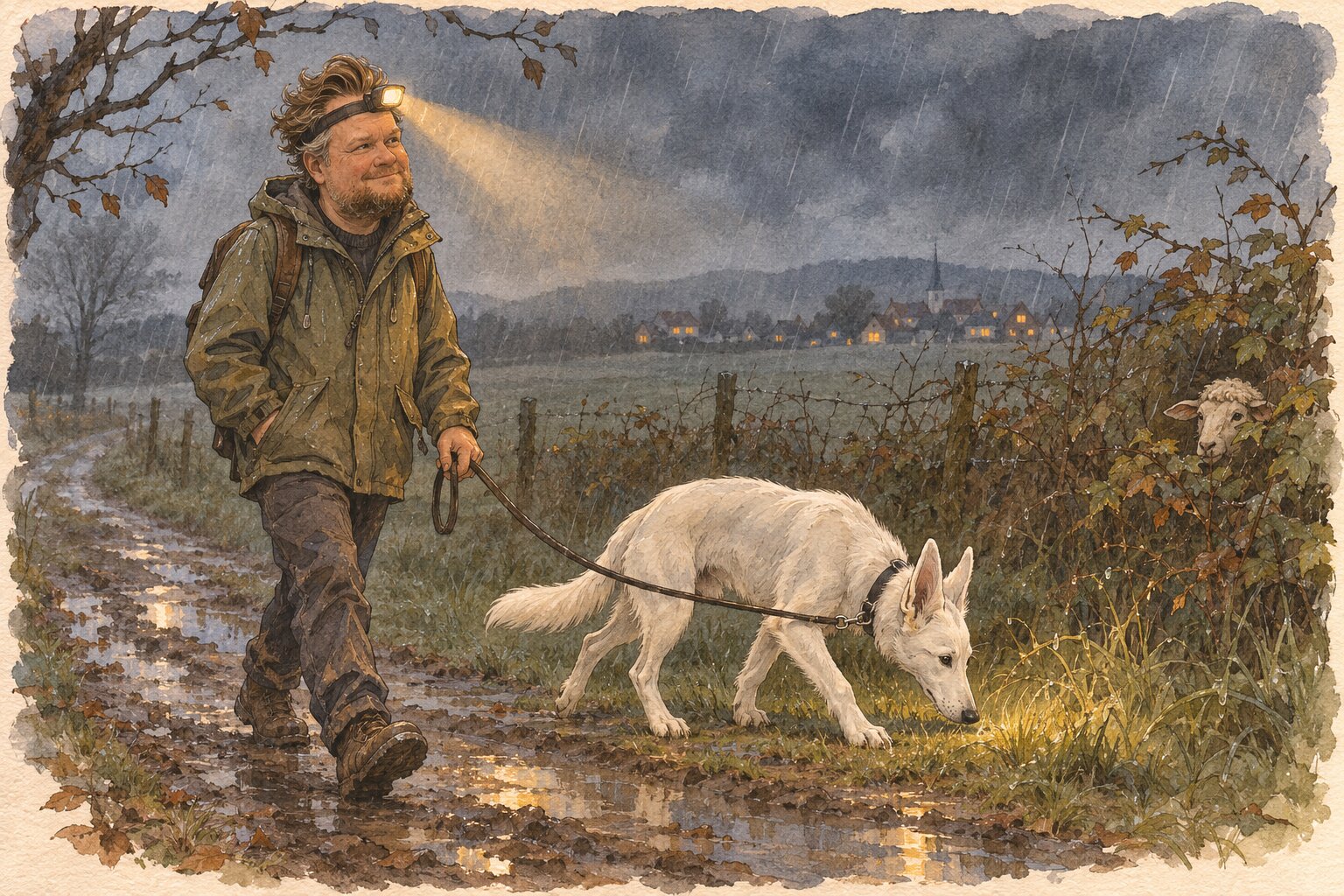
The best thinking I do these days happens on the evening round with Flocke. It’s dark at five now, the fields are wet, she is busy with whatever the rabbits left behind, and I have forty-five minutes in which nobody wants anything from me. Lately, those forty-five minutes have been circling around one question, and it doesn’t go away when I’m back at the desk: what am I going to do for a living in five years?
The last time I wrote a post like this, it was called “Uneasiness”, it had exactly five sentences, and it was about bad contract projects in 2010. This one is longer, because this time the cause isn’t a couple of bad customers. It’s the whole trade.
The flip side of my own argument
Back in August I wrote that software no longer needs a business case, and I meant every word of it. LLMs made it cheap enough to finish the tools nobody would ever pay for, and I’ve been happily doing exactly that all year.
What I didn’t write is the obvious other half of that sentence: if software no longer needs a business case, then software is no longer much of a business, either. At least not the kind of business I’ve been doing since the late nineties — somebody has a problem, somebody else (yours truly) knows how to turn it into a program, and money changes hands in between. When the person with the problem can say what they want and get a working program back in an afternoon, the one in the middle has a problem of their own.
The part that excites me
Don’t get me wrong, I’m not only scared. Some of it is the most exciting thing that has happened to computing since I first typed LOAD"*",8,1.
For forty years we’ve been interacting with computers through applications. An app is basically a container: some data, a set of verbs you can apply to that data, and a user interface that tries to explain to you which verb lives behind which button. Half of my professional life consisted of discussing button placements for those containers.
Now look at what happened at my own bench this spring: I gave a model typed tools for a CAN bus, and it read a VIN off an ECU. No app involved. I said what I wanted, the model picked the verbs, the verbs acted on the data. I’m convinced that this is where most of our interaction with computers is going: we won’t open apps anymore, we’ll just perform actions on data, and the human-computer interface will be language by default. Not because typing or talking is always better than clicking, but because it removes the need for someone to anticipate every verb in advance and give it a button.
Funnily enough, I made a similar point in 2008, in a completely different context. Back then, for the Openmoko middleware, my line was “below the dbus line we collaborate, above it we compete”. MCP is that dbus line all over again, just for the whole world. The difference is that above the line, there isn’t much left to compete with. The model is the frontend.
There will still be dedicated graphical applications for things where the picture is the point: a DAW, a tracker, a frame view with two million CAN frames in it, a map. But those are special cases. The recipe app, the expense report, the ticket system, the CRM with the 47 tabs… I won’t miss them, and I doubt anyone else will.
The part that scares me
Here’s the catch. If interaction becomes language and programs become something a model writes on demand, then software development as a service is a commodity. Not a cheaper craft, a commodity, like electricity: you need it, you pay per unit, and nobody cares who generated it.
I’ve lived through a smaller version of this before. In 2013 I complained that HTML5 and cross-platform tools were ruining the prices for native apps. That was a dent. This is the floor going away. The 20-person-day fixed-price projects I quit doing in 2014 — today the customer gets the first 80 percent of that for the cost of a subscription, and the remaining 20 percent… well, I’ve been preaching for years that the other 90 percent is where the actual work is. That still holds. I’m just no longer sure that customers will pay for it, when the first version already looks finished to them.
The electricity comparison bugs me for another reason. Nobody cares how the power plant is wired inside, as long as the lights come on. For a lot of us, though, the pride was precisely in the wiring: clean module boundaries, state machines instead of flag soup (they’re your friend, as I wrote in 2008), reusable frameworks because I hate repeating myself, code that somebody else can still maintain in ten years. That whole ethos rests on one assumption: changing software is expensive, so you’d better build it in a way that it can be changed. If regenerating the whole thing from a description is cheaper than understanding the old one, why would anyone care whether it was modular? Throwaway software doesn’t need to be maintainable, it needs to be replaceable.
I’m torn on this one. My gut says architecture matters more than ever. The model works best inside small modules with typed boundaries (my agent at the bench got sharper with every structured tool I gave it), and a big ball of mud eats its context window just like it eats my patience. And the freshly regenerated program still has to talk to the same database, the same ECU, the same customer data from last year — data outlives code, always has. Then again, my gut also told me in 2020 that Objective-C would carry me through the rest of my career. Maybe clean architecture survives as something we do for the machines rather than for each other, which would be a strange kind of victory. Or maybe it ends up like letterpress printing: admired by a few, and irrelevant to everyone else.
And the part that hurts personally is not the money. It’s that writing software has always been the creative act for me, from 68K demos on the Amiga to the tracker I’m building right now. If that act can be performed by anyone who can describe what they want, then what I’m good at has no creative value on the market anymore. It still has value for me, at the bench, at three in the morning. But that doesn’t pay for dog food.
So where do people like me go?
I don’t have the answer. I do have a few candidates, ordered by how much I believe in them.
Where software touches physics. Hardware doesn’t care about plausible explanations ;) An ECU either answers or it doesn’t, a CAN controller goes bus-off or it doesn’t, and someone has to stand in the workshop with the adapter in one hand and the laptop in the other. This is where I’ve been drifting for ten years anyway, with the adapters, CANcorder, ECUmulator Studio and the Touch. Models will learn a lot from benches, too, but they won’t hold the probe for some time.
Where someone has to sign. Safety, homologation, liability, regulated industries. A model can write the code, but it can’t be sued, and as long as that’s true, someone needs to understand what they are putting their name under. That’s a real job. It’s also a much smaller one than “developer” used to be, and I’m not sure it’s a job I want.
Where knowledge isn’t in the training data. What a particular 2009 ECU actually does when you send it a malformed request is written down nowhere. It’s in my notes, in my bench logs and in my head. That’s worth something, but it’s a shrinking island: every time I hand that knowledge to a model as a tool, I’m moving it from my head into the commons. Which is exactly what I want as an engineer, and exactly what I shouldn’t do as a businessman sigh.
Taste. Deciding what should exist, and what it should feel like. I keep reading that this is what’s left for us humans. Maybe. But I’m afraid taste feeds a few dozen people per industry, not a few million.
Things that are worth something because a person made them. Stories, music, a hand-set book in FF Meta. That’s where my heart is going anyway. The irony isn’t lost on me that I wrote those with a model at my side, too, and that this post was also mostly typed by one. Still, there’s a difference between a model that keeps me from stopping halfway and a model that replaces the need for me to start at all.
Or I breed sheep
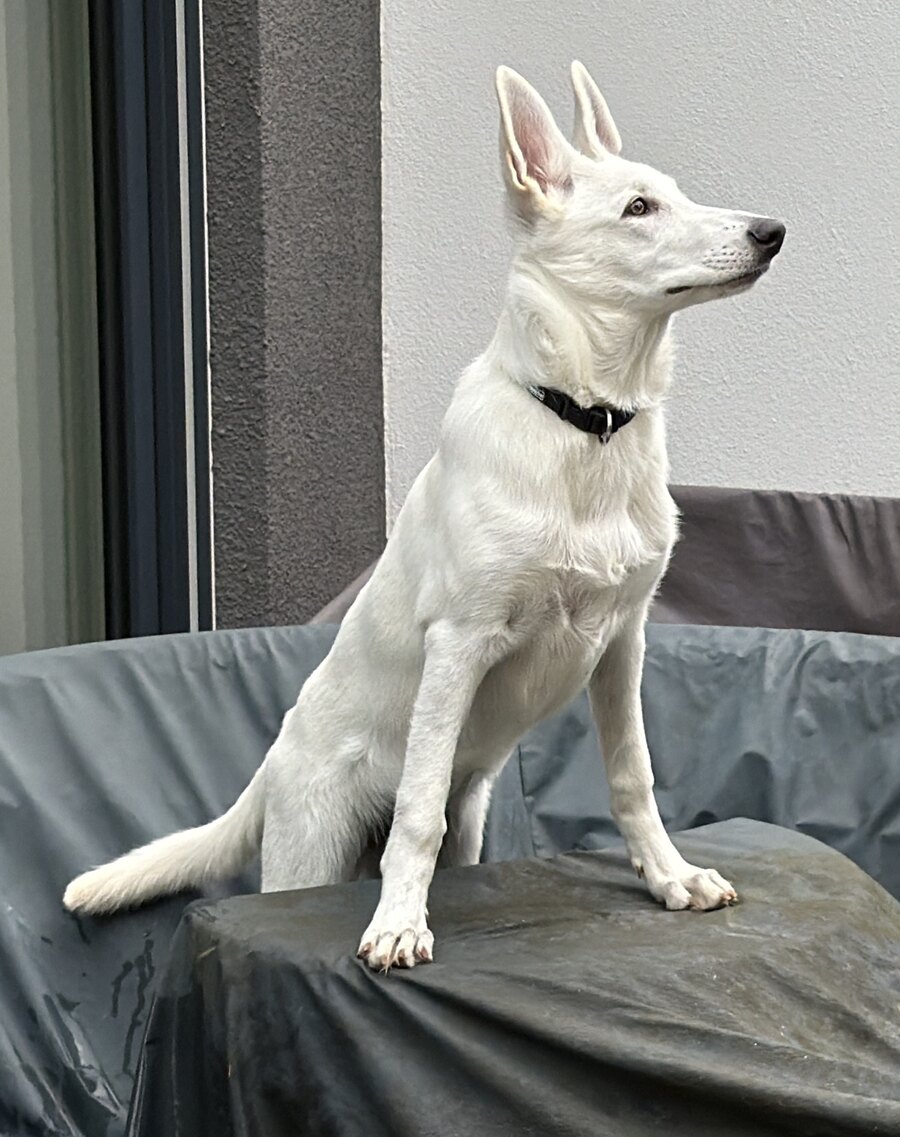
Which brings me back to the evening round. I’ve been jokingly telling friends that if it all goes south, I’ll breed sheep. The shepherd dog is already here, after all: Flocke is a White Swiss Shepherd, she has the herding instinct (mostly applied to family members who walk in different directions), and she is clearly underemployed. Whether she would actually herd the sheep or just chase them into the next county is a question I’d rather not answer in public.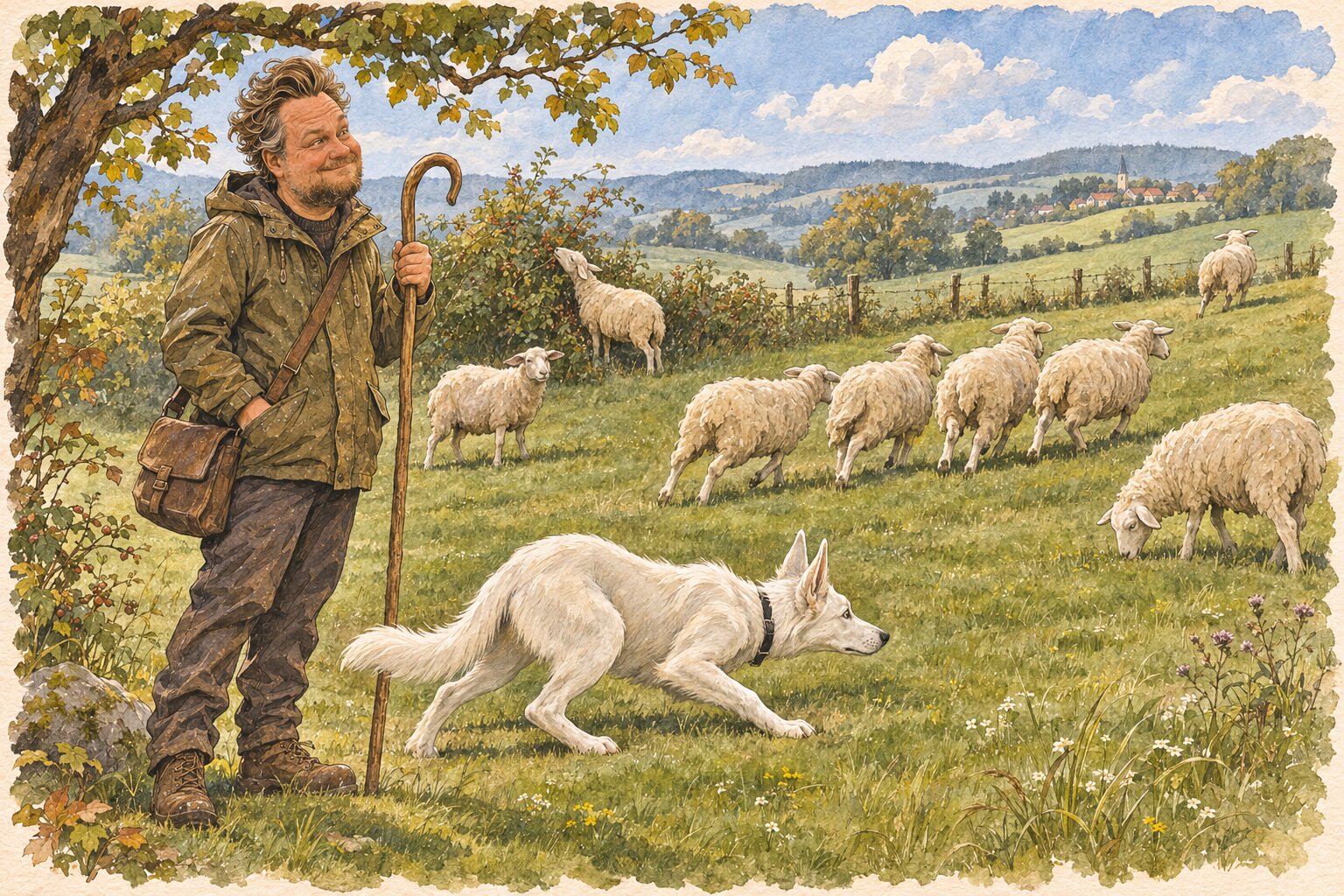
I’m not breeding sheep. Not yet. For now I’m doing what I’ve always done when the ground was moving: building the things I believe in, as close to the hardware as I can, and keeping my eyes open. But I’d be lying if I said I knew where this goes, and I’ve noticed I’m not the only one in my age group who is quietly asking the same question on long walks.
So, dear reader — especially those of you who’ve been making a living from code for as long as I have: where do you see yourselves in five years? Did you already find your sheep? I’m all ears.
Cheers, :M: