Field Recording Again
As mentioned in a previous installment of this column, I’m spending more time with music (and related tasks) again. To get some raw material for new samples, I started recording in the field. The best device I can recommend in the mid-budget region is the Tascam DR100 recorder – this device comes with an aura of “work, not play”; unlike the famous Zoom devices which I found to be very plastic and unreliable. The killer features of the Tascam DR100 for me are:
- Built-in rechargable Li battery
- 2 XLR inputs w/ 48V phantom power
- 4 built-in microphones, two uni-, two omnidirectional.
- Simple UI, lots of dedicated buttons.
One week in Paris
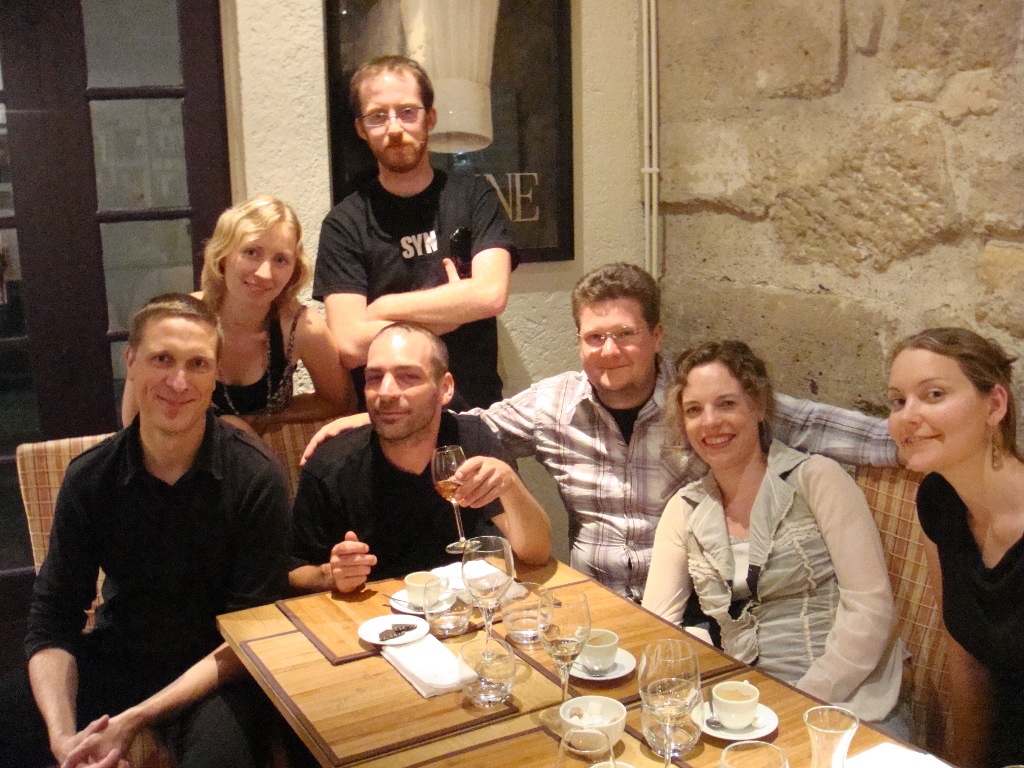
Sabine and me spent a week in Paris to celebrate our 8th wedding anniversary. It’s pretty amazing that the ICE train takes only 4h from Frankfurt/Main to Paris, Gare de l’est – this is almost the same amount of time it takes me to get to Berlin…
Besides walking all around the city and visiting some sites, I took the chance to visit the Bearstech office and chat a bit with the guys there. Unfortunately only few bears were there at that time, but with only 4h to Paris, I’ll be surely coming back more often. On the last day, we had a (yummy) dinner with some guys and their gals from SHR and openBmap fame. It was a great evening and a very nice conclusion to our small vacation, thanks guys!
 {width=“320”}
FSO founds BGB company
We just released the following statement to various mailing lists:
Braunschweig, Germany, 2009-07-29. For immediate release.
The freesmartphone.org core-team founds a BGB company to facilitate the further development of free and open source middleware for Linux-based mobile systems: “Lauer, Lübbe, Schmidt, Willmann, freesmartphone.org GbR”.
The core-team members of the freesmartphone.org project today announced the founding of a legal entity offering consulting, training, and implementation services around the freesmartphone.org middleware platform, also known as FSO.
“We now have a single point of contact for both commercial and non-commercial parties who want to use our services to create compelling solutions. This is of interest for groups or individuals creating new devices or freeing existing devices (“anti-vendor-ports”) and who decided to incorporate the FSO middleware“, says Dr. Michael Lauer, founder of the FSO project. “If you care about the further development of this platform or if you need guidance for tailoring or customizing the FSO middleware, contact us via E-Mail at coreteam@freesmartphone.org”.
With todays’ smartphones evolving into ubiquituous companions, a gap has emerged between widely used FOSS components like the Linux kernel and core system libraries on one side, and end-user applications on the other side. The lack of a complete free mobile software stack hinders innovation and leads to reinventing proprietary solutions for services middleware.
FSO’s mission is to close this gap by designing and developing solid middleware for mobile systems in an open fashion; this refers to not only publishing source code under open source licenses, but also to sharing the whole design and development process with the community and giving both commercial and non-commercial entities a way to co-drive and steer the process.
Built on top of the Linux kernel, FSO implements high level services for mobile application development, accessible via the DBus interprocess communication standard. Leveraging the FSO APIs allows the developer to concentrate on solving application domain problems, such as business logic and presentation of data, without having to worry about the device specifics and low level details, such as how to access resources, telephony, location awareness, data storage, etc.
*About freesmartphone.org: Previously funded by Openmoko Inc, freesmartphone.org is a collaboration platform for open source and open discussion software projects working on interoperability and shared technology for Linux-based smartphones. freesmartphone.org operates on the services layer (middleware) and offers APIs and reference implementations that support modern interconnected mobile devices. To provide reference solutions, freesmartphone.org works closely together with various device-specific communities such as the Openmoko, OpenEZX, and HTC-Linux groups. The FSO team honours and bases on specifications and software created by the freedesktop.org community. * This means you can hire us (or donate money), if you want to support the FSO middleware development.
Updating the Recording Studio
Although I kept working on my instrument skills, I neglected my recording studio for about a decade now. I guess the root of the problem is that I never got the hang of the modern computer based sequencers. The moment when I sold my KORG 01/W workstation (almost a decade ago) was the moment I more or less quit recording anything.
While I’m working with computers for a living, I don’t like software instruments much – with one exception which is the reason for this post. I just acquired a Native Instruments MASCHINE – which is a dedicated hardware controller for a software instruments (a groovebox, actually). This is slowly bringing back my motivation to do some recordings.
As part of this motivation, I sold some of the gear that only gathered dust, namely an Akai MPC 2500, a Roland JD990 w/ VintageKeys extensions, and a BitStream WaveIdea controller. Less is more and keyboardwise, I’m feeling very confident with only a Roland V-Synth GT and a Roland V-Piano now.
Stay tuned for some releases… after so many years :)
Dreambox 8000
After the sudden death of my Dreambox 7025, the new OE-based device in the living room is a Dreambox 8000 unavailable – simply the best set top box money can buy these days. Yes, it’s quite expensive, but the hardware is fully loaded (heck, there’s even WiFi) and the freedom to install what you want is invaluable.
Openmoko Workshop in Munich
I’ll be present at the first Openmoko Workshop in Munich unavailable, gracefully organized by Dr. N. Schaller (Goldelico) hosted at the University of applied science unavailable in Munich. Topics will be developer-oriented, but beginners are also invited. There are only few seats left, so please contact Dr. Schaller via the freeyourphone.de forum, if you want to be on board.
I’ll be talking mainly about freesmartphone.org – the beginning (2002-2008, from handhelds.org to openmoko.org), the present (2009, how to program with FSO), the future (2010-, what the Vala rewrite will bring and how we get FSO to more hardware).
This is just a loose gathering to get started. If there is sufficient interest, we will consider turning this into a more formal (professional) training course in the future. Hope to see you there!
POS will die
From everywhere you hear the whining and complaints of local points of sale that the internet is taking away their business foundation. Whenever I buy a new device, I try to countervail this effect by going to my local shop to buy it there instead of doing the couch potato buying it over the internet. However 9 out of 10 times I get disappointed by them not having what I want in stock. If I wanted to order it to get it later, I had ordered it online in the first place :(
This morning I went to a local shop to buy a new communications device with a contract – these point of sales get quite a nice provision when people buy contracts. To my surprise, they had the device I wanted in stock and I felt growing excitement. Then I grabbed a piece of paper showing them a special employee rebate code I got from another employee and guess what… “oh, with these kinds of rebates devices can only be ordered at the support hotline”… WTF?
With this policy, points of sale will die – it’s inevitable. They are digging their own grave and I have no more symphathy.
LinuxTag 2009
I’m on my way to LinuxTag 2009. Instead of a “real booth” like last year, we settled on a developer table in the hacking area – there we can present our Linux on mobile projects such as
in a more relaxed way – giving room to dive into some technical issues, when interested folks come around.
Find me there, if you’re interested in any of the aforementioned projects. I’ll be there until Friday afternoon.
Sid Player 1.2.49
We have just submitted Sid Player unavailable 1.2.49 to Apple. Highlights of changes in this revision include:
- Author Tab: In offline mode, only show authors for which songs are available,
- Underrun Detection: Relax threshold a bit, add setting to turn it off completely (for you jailbreakers…),
- Settings Tab: Enable switching between multiple SID models,
- Files Database: Files are no longer stored on your filesystem, but in a database. This fixes the incredibly annoying iTunes synchronization times. NOTE that we had to wipe all your data during the upgrade to make this happen.
and finally the first step towards the #1 wanted feature…
- Added four playlists: “Favorites”, “My Top 50 Played”, “Random 100”, “HVSC Top 100”.
- Enable reordering all playlists and adding/removing songs from/to the “Favorites” list directly from the Player screen.
Although we wanted to ship more smaller updates, this one has become a major update and took us a while. I hope it gets past the review pretty fast, so you can enjoy our latest work!
NB: The newest iPhone 3G[S] excited us a lot, especially since we already max out CPU power on the current models. We’re looking forward to enabling stereo and to add some nice post processing effects in a special Sid Player version once this model is out. Stay tuned!
NB2: Yes, we know that the HVSC team has released v50, however they have substituted a lot of PSID versions with RSID versions, which – although they might sound better – do no longer play given the limited CPU power of the iPhone and iPod Touch. I’m sorry, but until faster models appear, we can not ship the updated SIDs…
I'm in love
10 years of sound modelling research have just been unleashed:
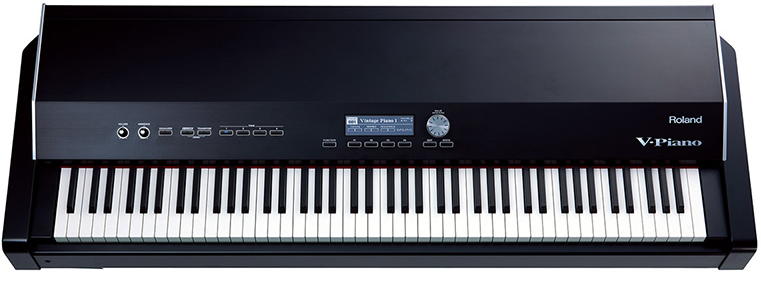
Roland V-Piano. No Samples Inside!